Real-time process visibility
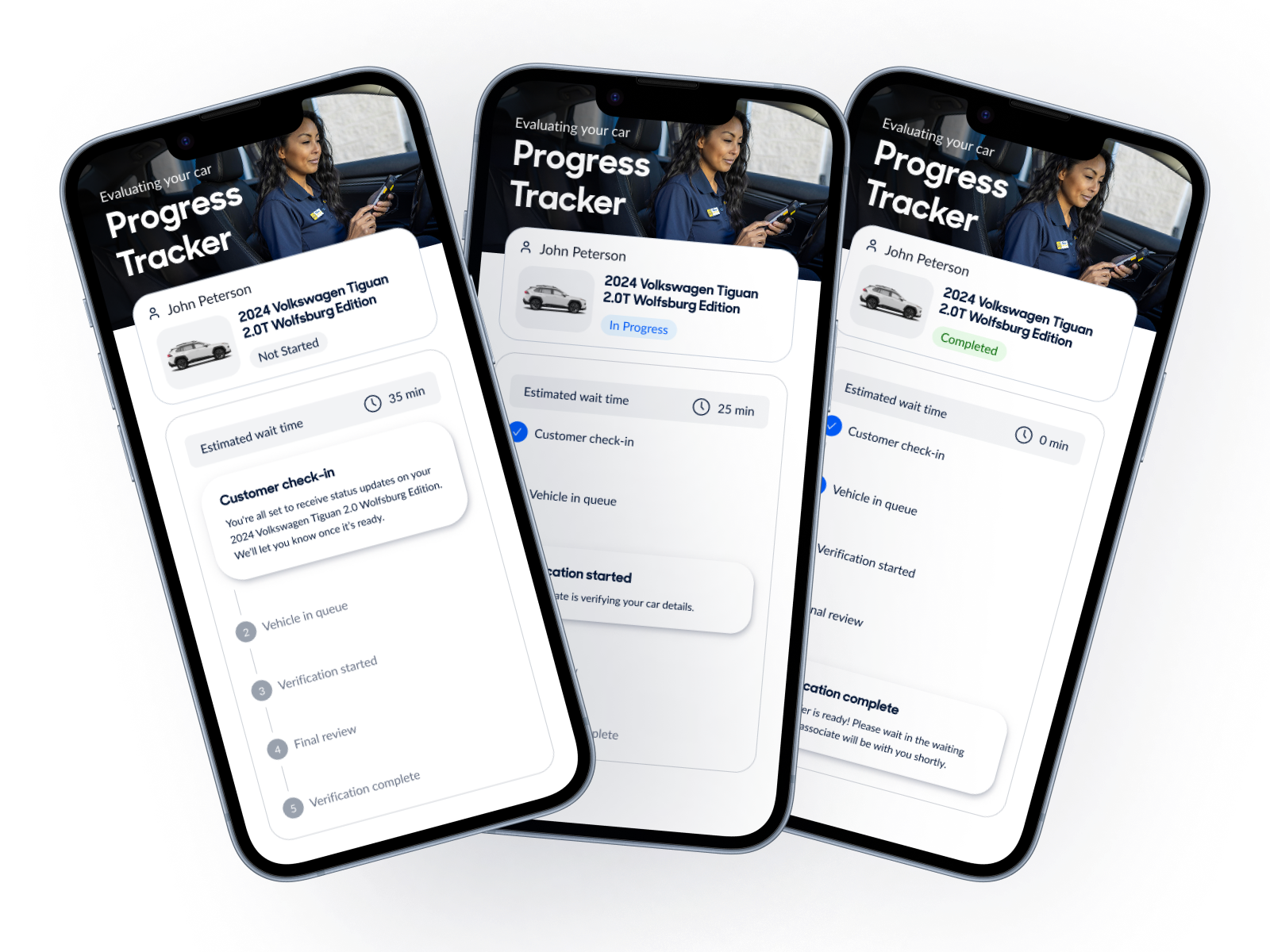
Turning a hidden, behind-the-scenes evaluation into a live tracker customers can follow from check-in to offer.
Role
Design Lead
Year
2026
The problem
The vehicle evaluation process involves multiple steps happening behind the scenes, but customers don't always have visibility into what is happening or how long the process may take. That lack of transparency can create uncertainty.
Same process, two views
What the customer saw
Checked in
Handed the keys over. That was the last confirmation.
Waiting
No status, no estimate, no way to tell if anything was moving.
Still waiting
Nothing changed on the customer's side from minute 5 to minute 90.
What was happening backstage
- 1
Appraisal in queue
The vehicle sits in line before anyone looks at it.
- 2
Verification started
Condition, options, and history get confirmed.
- 3
Final review
A second set of eyes locks in the offer.
- 4
Appraisal complete
The offer is ready. The customer just doesn't know yet.
The work was moving. The customer had no way to see it.
My role
Led the design of the customer-facing Vehicle Progress Tracker, translating complex internal evaluation workflows into a clear, transparent experience that helps customers understand their vehicle’s status and next steps.
Ownership & scope
Pod of 3–5 · 6–12 months
01
Research & discovery
02
Strategy & definition
03
Concept & prototyping
04
Design, build & launch
Kamarin, Design lead
Store & field operations
Product
Engineering
Key decisions
Show the work, not a spinner.
- Grouped the internal evaluation work into five plain-language steps customers can follow.
- Paired every step with a shrinking time estimate, from 30–35 minutes down to 0.
- Ended on a clear next action: the offer is ready, where to go, and how long it's valid.
Backstage, translated
- Customer hands over keys and paperworkCheck-in confirmed · 30–35 min
- Vehicle moves into the appraisal laneIn queue · 25–30 min
- Title, mileage and condition checks runVerification started · 15–20 min
- A second set of eyes locks in the numberFinal review · 5–10 min
- Offer approved in the systemComplete · offer ready, valid to 01/31/2025
Nothing was invented for the customer. Each screen is one real handoff, named in plain words.
Outcomes
Showing the work was the fix. Customers who could see the process trusted the number at the end of it.
- The process teaches itself. Five named steps, each with its own wait, show a customer what happens next without anyone having to explain it.
- An explained wait is a different wait. Twenty minutes with a reason on screen is not the same twenty minutes with nothing.
- Trust in the number. Customers who followed the evaluation were more willing to accept the offer because they watched the work happen in real time.
The states that shipped
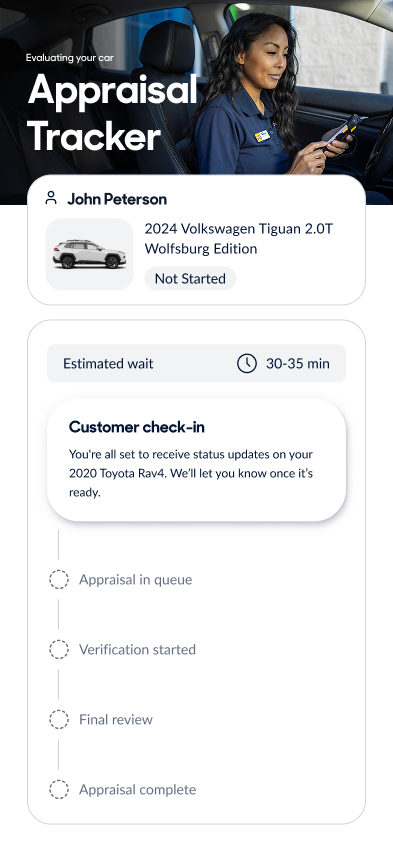
01 · Customer check-in
The wait opens with a name, a car, and a number.
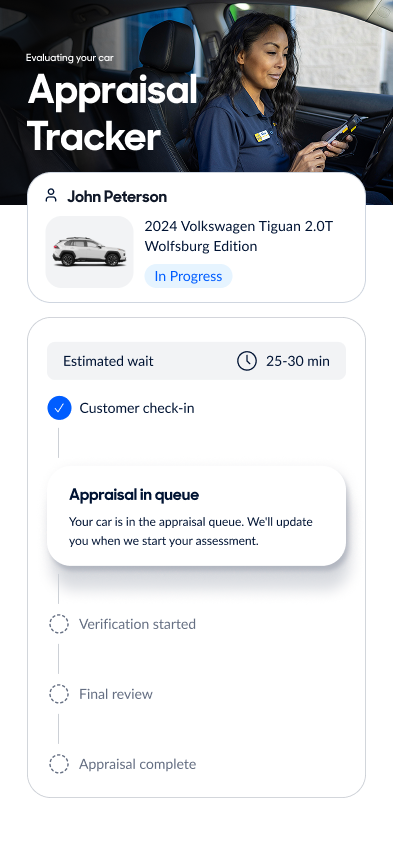
02 · Appraisal in queue
Customers can see they're actually in line.
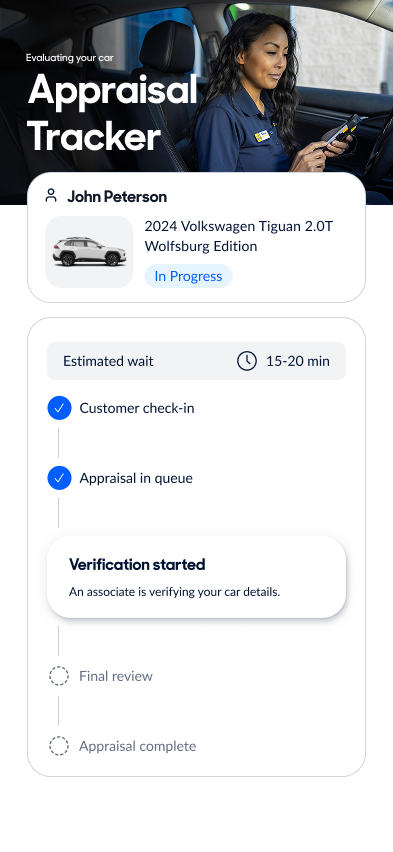
03 · Verification started
The longest gap in the process now has its own label.
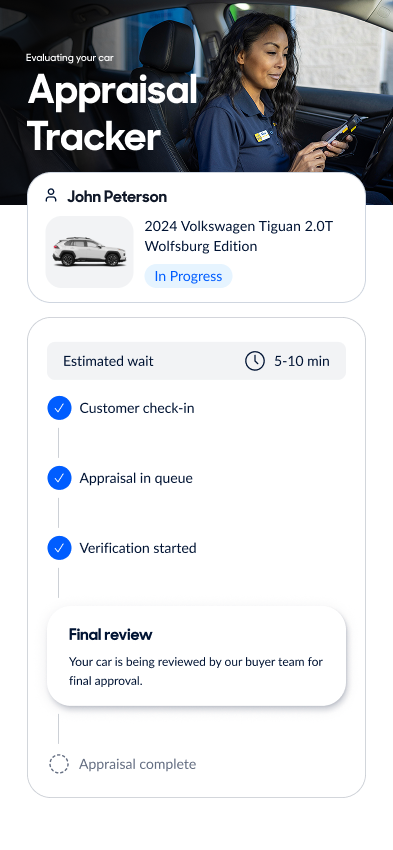
04 · Final review
The estimate keeps dropping as the offer closes.
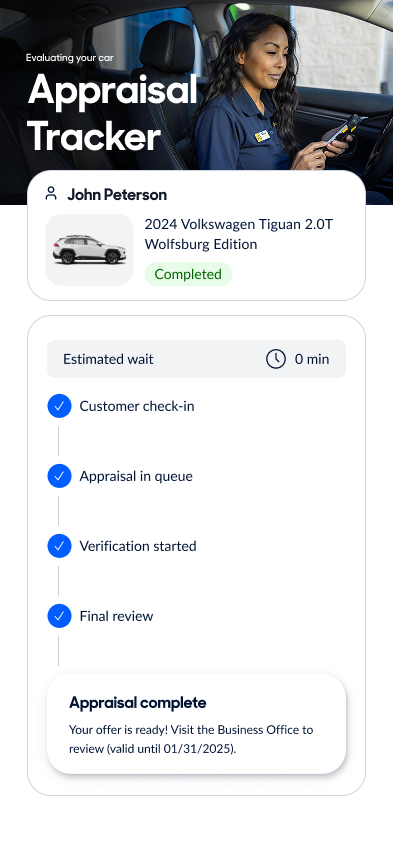
05 · Appraisal complete
Ends on the offer itself: where to go, and how long it's valid.
Five states, one rule: the customer always knows which one they're in.
Transferable problem spaces
AI-powered · Ask anything
Ask about this case study
Describe what you want to know. Answers come only from this portfolio.
Next case study
Designing Confidence Into the Car-Buying Journey.→